


 Friendys
 United Ukraine
 Bidfax
 Plăţile
 GenAp group chat
 Adsline MarketPlace
Electric Vehicle Battery Health Before You Buy
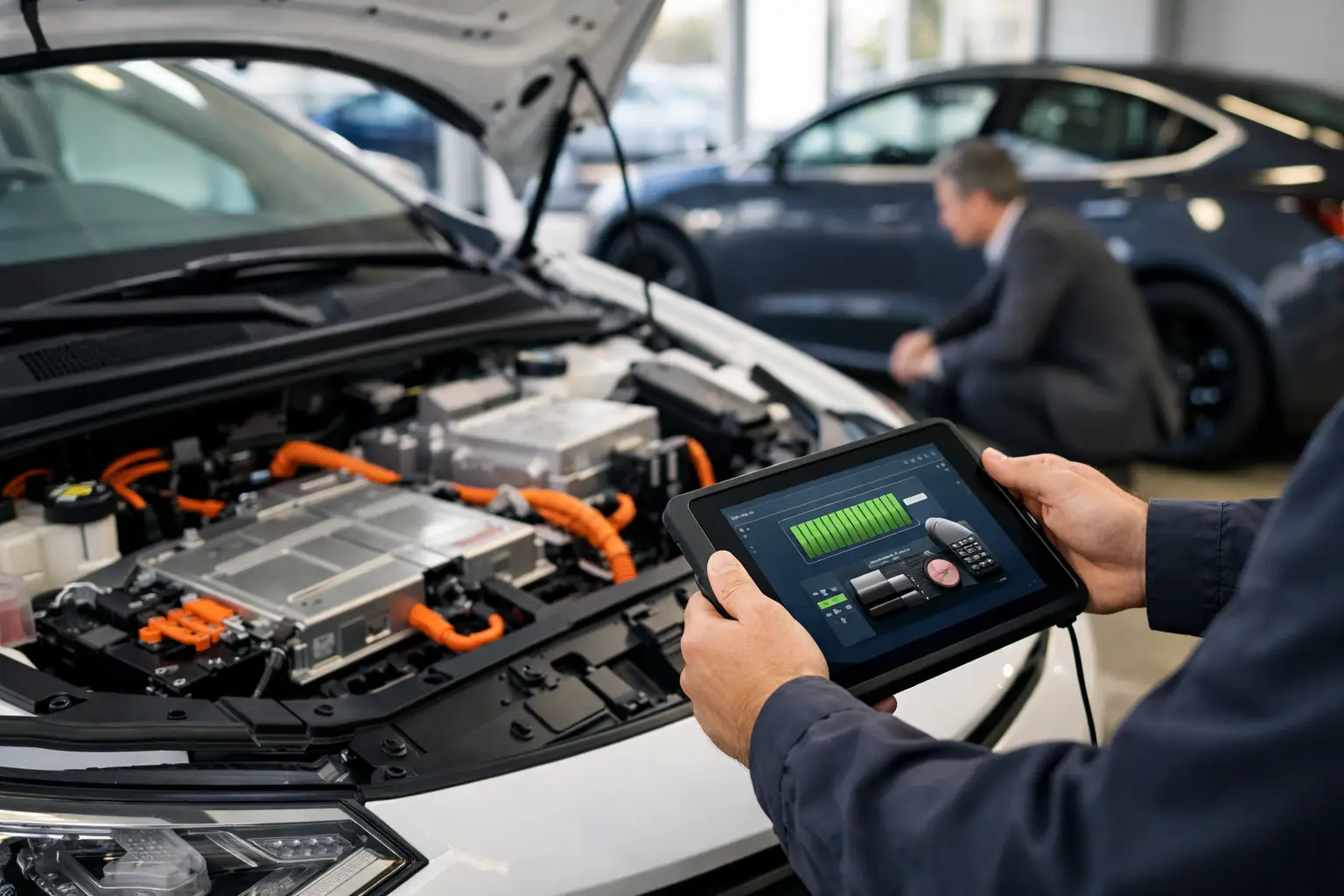
A used EV can look like a great deal right up until the first long trip exposes a much shorter range than expected. Electric vehicle battery health is one of the biggest factors behind an EV's real value, but it is not always obvious from the odometer, a clean exterior, or the range number shown on the dash.
For buyers, battery condition should be part of the same conversation as title status, accident history, tire wear, charging equipment, and service records. For sellers, clear battery information can prevent wasted messages and help serious buyers understand exactly what they are getting.
What electric vehicle battery health actually means
Battery health usually refers to how much usable energy the high-voltage battery can still store compared with when it was new. This is commonly described as state of health, or SOH. A battery at 90% state of health has lost roughly 10% of its original usable capacity.
That does not mean the vehicle has lost exactly 10% of its driving range. Range also changes with speed, outside temperature, elevation, tire pressure, HVAC use, wheel size, and driving style. A cold-weather highway test can show a much lower number than a mild-weather city drive, even with a healthy battery.
There is also a difference between normal degradation and a battery problem. Most EV batteries lose some capacity gradually over time. A major fault can involve warning lights, charging limits, overheating, a failed battery module, or a sudden and unusual drop in range. Normal aging affects price. A diagnosed battery fault can affect whether the vehicle is practical to own at all.
Start with the battery warranty
Before making an offer, check the original battery warranty for that specific year, make, and model. Many EVs sold in the US carry high-voltage battery coverage for eight years or 100,000 miles, while some offer longer mileage limits. Terms vary by manufacturer and may differ for vehicles first sold in California or other states that follow stricter emissions rules.
Warranty coverage is not a promise that the battery will remain like new. Most warranties cover a defined capacity loss threshold, often around 70%, or a defect in materials and workmanship. A battery at 78% capacity may feel noticeably aged to a buyer but still fall outside warranty replacement rules.
Ask whether the warranty transfers to the next owner, whether it remains active after a salvage or rebuilt title, and whether prior repairs appear in dealer service records. Title history matters here. A flood-damaged EV, for example, raises very different battery questions than a clean-title EV with ordinary mileage.
Do not rely only on the dashboard range estimate
The range estimate on the instrument cluster is useful, but it is not a certified battery report. It is usually based on recent driving conditions and can move quickly after a stretch of aggressive driving, cold weather, or efficient city commuting.
A seller may show a fully charged vehicle with a strong-looking estimate, but the number alone does not tell you how the car performs at 70 mph with the heat or air conditioning running. On the other hand, a lower estimate does not automatically mean poor battery health if the vehicle has been driven in winter or on short trips.
Look for context. Compare the displayed range with the model's original EPA rating, then account for age, mileage, weather, and configuration. A large SUV, truck, or performance EV with wide tires will naturally use more energy than a compact EV. The right question is not simply, "Is the range lower?" It is, "Is the range loss reasonable for this vehicle and its history?"
Ask for proof, not guesses
The strongest battery evidence is a recent diagnostic report from a manufacturer dealer, qualified EV repair shop, or trusted battery-health testing service. Depending on the vehicle, a report may show state of health, usable capacity, battery fault codes, cell balance, charging history, and whether the battery management system has active alerts.
Not every seller will have a formal report. That is common with private-party listings. In that case, ask practical questions: Has the vehicle ever displayed battery, charging, or powertrain warnings? Has it had a high-voltage battery repair or replacement? Does it fast-charge normally? Is the range estimate stable? Are there service invoices available?
A seller who says, "The battery is perfect," without records is offering an opinion. A seller who provides a diagnostic result, warranty details, and service documentation is giving you information you can use to price the vehicle.
Inspect the EV like a buyer, not a spectator
A thorough test drive should include more than a lap around the block. Start the vehicle from cold if possible, check for warning messages, and watch how the displayed battery percentage changes during normal driving. Test acceleration, regenerative braking, climate control, and navigation if the vehicle has it. These systems can reveal issues with the broader electrical system, even when the battery itself is not the cause.
If charging is available, connect the vehicle to a Level 2 charger and confirm that it begins charging without errors. DC fast charging is worth checking when practical, especially for buyers who plan to road-trip. A vehicle that repeatedly limits fast-charging speed, refuses to charge, or posts a warning message needs more investigation before money changes hands.
Use this inspection checklist when comparing used EV listings:
- Confirm the VIN, title status, mileage, and original battery warranty.
- Review service records for battery, charging, cooling-system, or high-voltage repairs.
- Request a battery-health report or schedule an independent EV inspection.
- Check the charge port, charging cable, underbody shields, and battery-area panels for damage.
- Test Level 2 charging and, if possible, DC fast charging.
- Compare the current range estimate with the model's EPA range and local weather conditions.
Underbody damage deserves special attention. The battery pack is often mounted low in the vehicle floor. A scrape on an exterior panel may be cosmetic, but a hard impact underneath can be expensive. Do not assume a rebuilt EV is a bad purchase, but require documentation that explains the damage, repairs, inspections, and any effect on warranty coverage.
Mileage matters, but age and use matter too
Low mileage is generally helpful, but it is not the entire battery story. Batteries age from calendar time as well as driving cycles. An older EV that spent years parked at very high charge in extreme heat may have more degradation than a newer, higher-mileage EV that was regularly driven and maintained.
Frequent DC fast charging can add wear, particularly in older battery designs, but it is not automatically a deal breaker. Modern EVs actively manage battery temperature and charging rates. A commuter who fast-charged occasionally may have a healthier pack than an owner who rarely drove the vehicle but left it sitting at 100% for months.
Climate is another factor. Heat is generally harder on long-term battery capacity than cold, while cold mainly creates a temporary range reduction. Ask where the vehicle has lived and how it was stored. Garage-kept history, moderate charging habits, and regular use are useful details, though they should not replace a real inspection.
Pricing a used EV with battery condition in mind
Battery condition should influence the deal, not automatically end it. A vehicle with moderate, documented degradation may still be an excellent value if its remaining range fits your commute, charging access, and budget. A 20% range reduction matters much more to a buyer who drives 180 miles daily than to someone with a 25-mile commute and home charging.
Think about resale, too. A used EV with clear battery documentation is easier to sell later than one with vague answers. If you are selling, include the current mileage, original EPA range, approximate displayed range at a stated charge level, warranty remaining, charging equipment included, title status, and any diagnostic report. Avoid claiming a specific state-of-health percentage unless it came from a credible test.
On AutoDeal, that kind of disclosure helps buyers compare vehicles quickly and gives your listing better footing when offers start coming in. It also makes direct chat more productive because the basic battery questions are already addressed.
When to walk away
A battery warning light, an unresolved charging error, visible underbody damage near the pack, or a seller unwilling to allow an inspection are valid reasons to pause. So is a price that ignores known degradation or an unclear title history involving flood, fire, or major collision damage.
There are exceptions. A discounted EV with a documented issue may make sense for a buyer with short-range needs, repair knowledge, or a clear path to warranty service. But that should be a deliberate purchase, not a surprise discovered after registration and insurance are complete.
The best used EV deal is not always the one with the highest range estimate. It is the one with enough verified range for your life, honest records behind it, and a price that reflects the battery you are actually buying.
 Romaian
 English
 French
 Spanish
 Portuguese
 Deutsch
 Turkish
 Dutch
Dutch
 Italiano
 Russian
 Portuguese (Brazil)
 Greek
Greek
